Search is changing. When you ask ChatGPT, Perplexity, or Google’s AI Overviews a question, you get an AI-generated answer instead of a list of blue links. This shift means traditional SEO tactics alone won’t get your content seen. You need Generative Engine Optimization—GEO—to make your content citation-worthy for AI systems.
GEO focuses on making your content the source AI engines cite when generating answers. Instead of optimizing for rankings on a search results page, you’re optimizing to be quoted, referenced, and linked in AI-generated responses. This matters because by 2026, an estimated 60% of searches end with AI-generated answers rather than traditional result clicks.
This guide explains what GEO is, why it matters for your content strategy, and which specific tactics make your content more likely to appear in AI-powered search results.
What Is Generative Engine Optimization?
Generative Engine Optimization is the practice of structuring and presenting content so AI systems recognize it as authoritative, clear, and citation-worthy when generating answers to user queries.
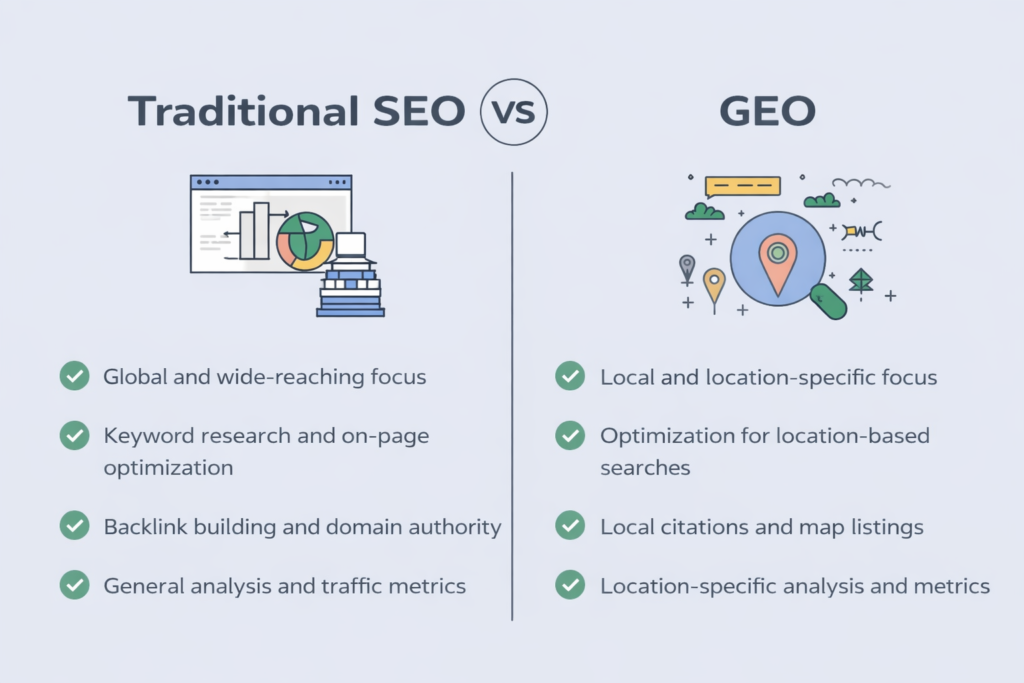
Traditional SEO optimizes for search engine algorithms that rank pages by relevance and authority. GEO optimizes for AI systems that synthesize information from multiple sources to generate original answers. The AI needs to understand your content, trust it enough to cite, and extract information cleanly.
Key differences from traditional SEO:
- Traditional SEO targets keyword rankings and click-through rates. You win by appearing in position 1-3 and earning the click. GEO targets source citations in AI responses. You win when ChatGPT, Gemini, Perplexity, or Google’s AI Overviews quote or reference your content in their generated answer.
- Traditional SEO relies heavily on backlinks for authority. GEO emphasizes content structure, clarity, and verifiable facts that AI systems can confidently cite. While backlinks still matter, citation-worthiness depends more on how easily AI can extract and verify your information.
- Traditional SEO optimizes for specific keywords. GEO optimizes for concepts and entities that AI systems recognize and connect. You focus on being the definitive source for a topic rather than ranking for individual keywords.
How AI Engines Select Content to Cite
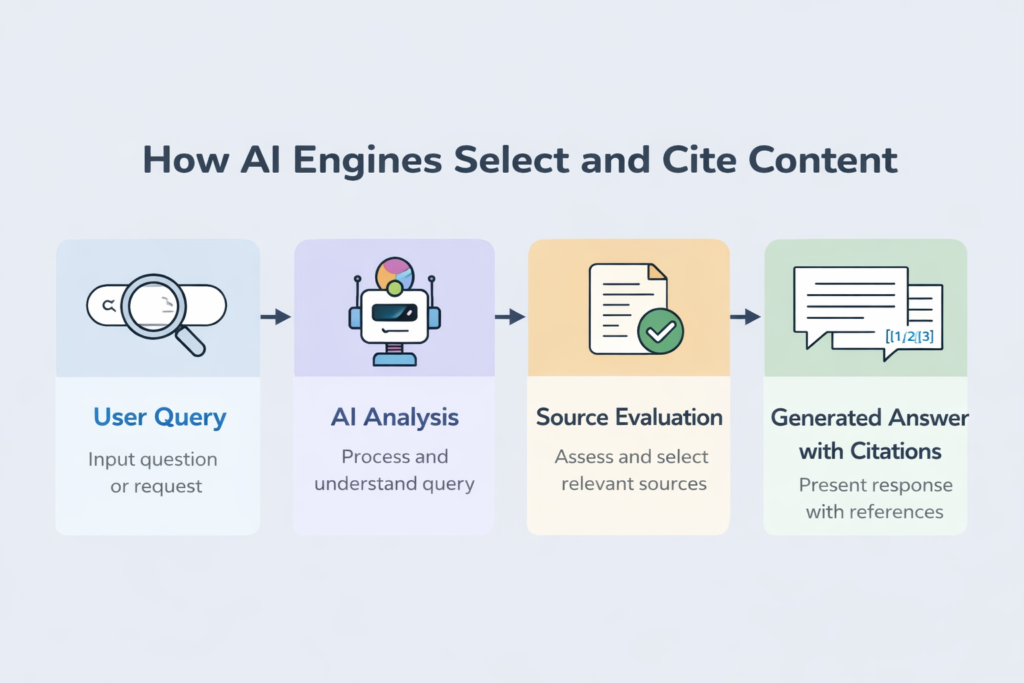
Understanding how AI systems choose sources helps you optimize effectively. When generating an answer, AI engines evaluate content based on several factors.
- Authority and trust signals come first. AI systems prioritize content from recognized authorities—educational institutions, established publications, verified experts, and sites with strong domain authority. They check for author credentials, proper citations, and factual accuracy.
- Content structure and clarity determine whether AI can extract information cleanly. Well-organized content with clear headings, concise definitions, and logical flow makes extraction easier. AI systems prefer content they can parse without ambiguity.
- Entity recognition helps AI understand what your content covers. Clear mentions of people, places, concepts, and their relationships help AI contextualize information. Defining terms explicitly rather than assuming knowledge improves recognition.
- Citation-worthiness means providing information that’s specific, verifiable, and unique enough to reference. Generic summaries rarely get cited. Original research, specific data, expert analysis, or comprehensive explanations earn citations.
- Recency and maintenance matter for time-sensitive topics. AI systems favor recently updated content with current information over outdated sources, especially for topics that change frequently.
Core GEO Tactics: Making Content Citation-Worthy
- Structure content for AI parsing. Use clear hierarchical headings (H2, H3) that describe section content. Start sections with concise definitions or direct answers before expanding. AI extracts information more easily from well-structured content.
- Create definitive sections answering specific questions completely. Consolidate related information in one comprehensive section that AI can reference as a complete answer, rather than scattering details throughout.
- Use lists, tables, and structured formats. Information in lists or tables is easier for AI to extract than paragraphs. Format steps, processes, and comparisons as numbered lists or comparison tables.
- Define concepts and entities explicitly. Don’t assume AI knows what you’re discussing. Define key terms on first mention, explain acronyms, and provide context for names or concepts that might be ambiguous. Write as if explaining to someone unfamiliar with insider terminology.
- Cite sources with direct links. When referencing studies, statistics, or expert opinions, link directly to the original source. Use specific citations like “According to a 2025 Princeton study…” rather than vague “research shows…” AI systems verify claims by checking citations.
- Write conversationally but precisely. Use clear, direct sentences in natural language. Avoid complex structures when simpler language works. However, precision matters—”increased by 34% over six months” is more citation-worthy than “significantly improved.”
- Create comprehensive topic coverage. AI favors content thoroughly addressing topics over surface-level summaries. Cover fundamentals, tools, implementation, mistakes, and measurement. Comprehensive means addressing what people need to know without obvious gaps, not just adding length.
- Include author credentials and expertise signals. Display clear author information with relevant expertise. AI weights content from identified experts more heavily. Include author bios with specific credentials, experience, and professional background to establish authority.
Optimizing for Specific AI Platforms
Different AI systems have different strengths and preferences. While core GEO principles apply universally, understanding platform specifics helps.
ChatGPT and Claude excel at understanding context and synthesizing information from multiple sources. They favor comprehensive, well-reasoned content with clear logical flow. These systems handle nuance well, so detailed explanations with examples work effectively.
Google’s AI Overviews integrate with traditional search, so established SEO signals like domain authority and backlinks remain important. Structure content with clear, concise answers at the beginning of sections since AI Overviews often extract the first substantive paragraph.
Perplexity emphasizes citation transparency, displaying source links prominently. Content that’s clearly organized with specific, verifiable claims performs well. Perplexity users often want detailed answers, so thorough coverage matters.
Gemini handles multimodal content well, understanding relationships between text, images, and structured data. Include relevant images with descriptive alt text and captions that add context.
Measuring GEO Success
Unlike traditional SEO, where rankings are clear, measuring GEO requires different approaches.
- Monitor AI citations directly. Search for your brand name, unique phrases from your content, or specific data points in AI systems. Track when your content appears as a source in generated answers. Set up alerts for your site name to catch citations.
- Track referral traffic from AI platforms. Google Analytics and similar tools show traffic sources. While AI-generated answers may not always drive clicks, some AI systems link to sources. Monitor referral patterns from ai.google.com, perplexity.ai, and similar domains.
- Measure branded search volume. As AI systems cite your content, more people discover your brand. Increased branded search volume in Google Search Console indicates growing awareness, often driven by AI citations.
- Monitor topic authority indicators. Track whether you’re earning backlinks from quality sources, being mentioned in industry discussions, or seeing engagement increases on content optimized for GEO. These signals are growing in topical authority that AI systems recognize.
- Test content in AI systems. Paste your content into ChatGPT, Claude, or Gemini and ask them to summarize it or answer questions based on it. If AI struggles to extract key points or misinterprets information, your structure needs improvement.
Common GEO Mistakes to Avoid
- Over-optimizing for keywords. Keyword stuffing or unnatural keyword placement makes content harder for AI to parse. Write naturally for human readers. AI systems understand context and synonyms well, so exact keyword matches matter less than clear communication.
- Hiding expertise. Anonymous or poorly-attributed content lacks credibility signals AI systems need. Always display author credentials clearly and establish expertise through demonstrated knowledge.
- Copying content from other sources. AI systems recognize duplicate content and won’t cite it when original sources exist. Create original analysis, unique insights, or novel combinations of information.
- Neglecting content structure. Long paragraphs without clear sections, missing headings, or poor information hierarchy makes extraction difficult. AI systems skip over poorly organized content in favor of clearly structured alternatives.
- Making unsupported claims. Statements without citations, vague assertions, or unprovable claims reduce trustworthiness. AI systems avoid citing dubious information. Back up factual claims with verifiable sources.
- Ignoring content maintenance. Outdated information, broken links, or references to deprecated tools hurt citation-worthiness. Review and update content regularly, especially for fast-changing topics.
- Focusing only on text. AI systems increasingly understand multimodal content. Complement text with relevant images, charts, or videos that add context. Use descriptive alt text and captions.
Getting Started with GEO
Start by auditing your best-performing content. Review your top 10-20 pages and ask: Is this structured clearly? Does it cite sources? Is the author’s expertise visible? Would an AI system find it easy to extract information from?
Implement these immediate improvements:
- Add clear author bios to all content showing relevant expertise and credentials. Include author photos and brief professional backgrounds.
- Review factual claims and add citations linking to original sources. Replace vague statements with specific, verifiable information.
- Improve content structure by adding descriptive headings, breaking long paragraphs into scannable sections, and formatting key information as lists or tables.
- Define important concepts and entities clearly. Explain acronyms on first use and provide context for specialized terminology.
- Update outdated content, fix broken links, and add “Last updated” dates showing content maintenance.
For new content, follow this GEO checklist:
- Clear, descriptive headings that preview section content
- Direct answers or definitions at the start of sections
- Lists or tables for steps, comparisons, or key points
- Citations for all factual claims and statistics
- Author credentials displayed prominently
- Comprehensive topic coverage addressing common questions
- Natural, conversational but precise language
- Defined concepts and entities for clarity
- Recent information with current examples
Build content depth gradually. Create comprehensive guides on topics where you have genuine expertise. Link related content together to establish topical authority.
The Future of Search and Content
Generative AI will handle an increasing percentage of information queries. This doesn’t mean traditional search disappears, but it does mean content strategies must evolve.
The sites that thrive will be those recognized as authoritative, trustworthy sources in their fields. GEO rewards genuine expertise, clear communication, and valuable information—the same things that make content valuable to human readers.
Focus on being the definitive source for your topics. Create content so clear, comprehensive, and well-cited that both humans and AI systems recognize it as the best available information.
GEO isn’t about gaming algorithms. It’s about making legitimately valuable content more accessible to the AI systems people increasingly rely on for answers. Start implementing these tactics today to position your content for the AI-powered search landscape of 2026 and beyond.


Leave a Reply