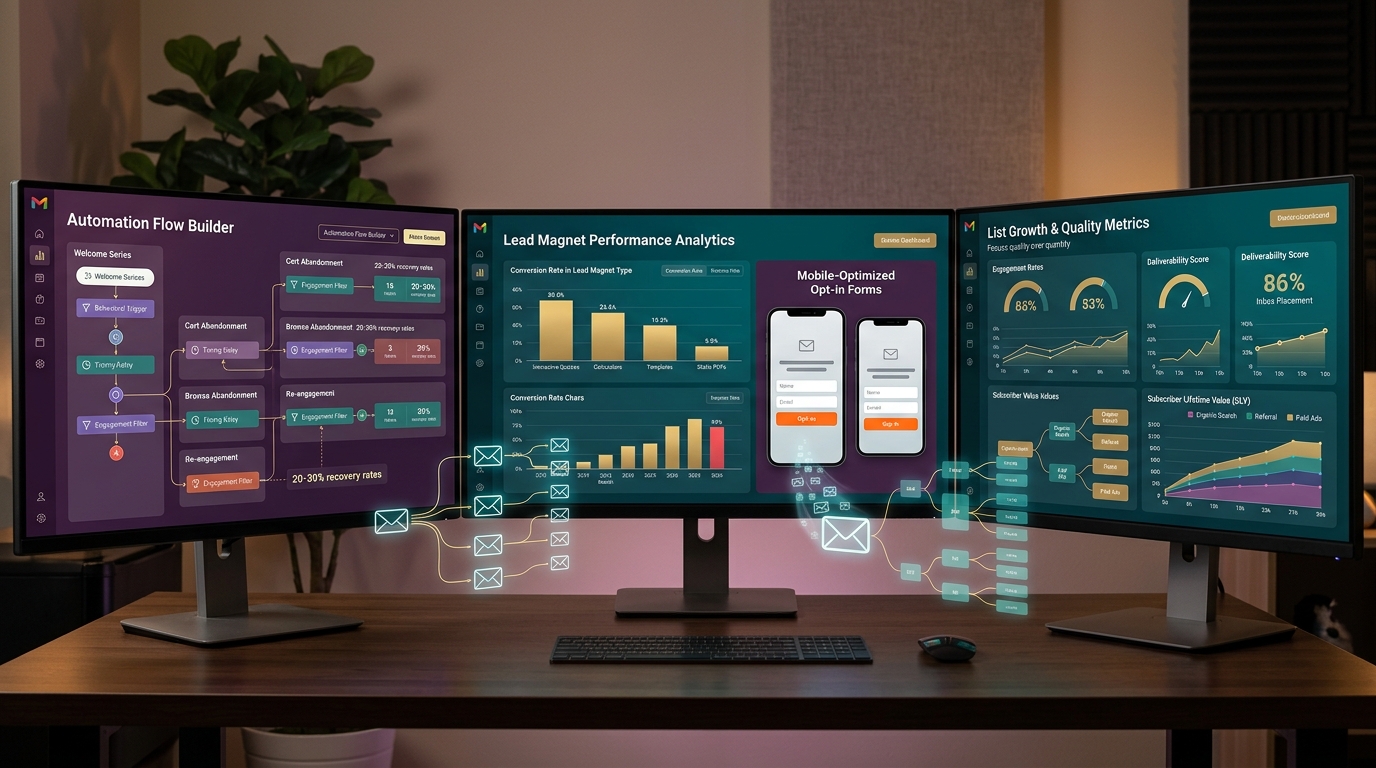
Email marketing delivers a $36 to $42 return for every $1 spent, while 74.7% of marketers actively grow their lists, yet 79% of marketing leads fail to convert without proper follow-up. The gap between list growth and actual conversion is massive. Interactive lead magnets now convert 70% better than static PDFs while automated emails drive 37% of all email-generated sales despite making up only 2% of total sends. Most marketers collect email addresses but fail at both stages. They offer generic “subscribe to our newsletter” buttons that nobody wants, then send batch-and-blast campaigns without strategic nurture sequences.
The shift isn’t temporary. It’s foundational to sustainable business growth. Research shows 90% of consumers willingly provide email addresses to trusted companies for relevant incentives, while 59% say marketing emails influenced their purchases. The permission-based relationship email enables beats every other marketing channel for direct customer communication. Yet 70% of marketers stop after sending one email, missing 76% of potential conversions that require systematic follow-up. The marketers seeing 1,000+ monthly list growth from strategic lead magnets and 20-30% cart abandonment recovery from automation flows aren’t using different tools. They’re implementing proven frameworks where value exchange drives opt-ins and behavior-triggered sequences drive conversions.
Success with email list building and automation in 2026 doesn’t require expensive platforms or massive budgets. It requires understanding how to create lead magnets, solving specific problems rather than offering generic resources, designing opt-in experiences optimized for mobile, where 81% of emails open, and implementing five core automation flows that handle welcome sequences, abandonment recovery, and re-engagement without manual sending. This guide shows you exactly how to build high-quality email lists and automation systems that convert subscribers into customers systematically.
Why List Quality Beats List Size in 2026
Buying email lists or growing quickly through low-quality tactics produces worthless audiences. Strategic quality-focused growth builds assets generating revenue for years.
Engaged Subscribers Drive Exponential Revenue
A highly engaged list of 1,000 subscribers who open 50%+ of emails and actually purchase generates more revenue than 50,000 disengaged subscribers with 10% open rates who never buy. The 55% average email open rate proves engagement matters more than size. Quality subscribers cost more to acquire initially but deliver dramatically higher lifetime value through repeat purchases, referrals, and sustained engagement over months and years.
Email Deliverability Depends on List Health
Poor list quality destroys sender reputation, landing all emails in spam regardless of content quality. When spam complaint rates exceed 0.1% or bounce rates top 5%, email providers throttle delivery automatically. The 86% of emails reaching inboxes versus 14% going to spam shows that deliverability directly determines whether optimization efforts matter at all. Maintaining list health through double opt-in, regular cleaning, and engagement-based segmentation protects deliverability, enabling actual inbox delivery.
Privacy Regulations Require Explicit Permission
GDPR, CCPA, and expanding US state privacy laws mandate clear consent for email marketing. Purchased lists and scraped contacts violate regulations, creating legal liability and financial penalties. The shift toward zero-party data, where subscribers intentionally share preferences, builds compliant lists while gathering actionable personalization data. Building lists properly from day one avoids legal problems while creating higher-quality audiences who actually want communication.
Creating Lead Magnets People Actually Want
Generic lead magnets like “subscribe to our newsletter” convert poorly. Strategic lead magnets solving specific problems convert 5% to 35%, depending on execution quality.
Solve One Specific Problem Immediately
The highest-converting lead magnets address single-focused pain points rather than broad topics. Instead of “10 Marketing Tips,” offer “5-Minute Email Template That Books Discovery Calls.” Instead of “Ultimate Guide to SEO,” provide “Google Search Console Setup Checklist.” This specificity proves immediate relevance, making opt-in decisions easy. Lead magnets converting above 15% share a common trait: visitors instantly understand the specific value they receive in exchange for their email addresses.
Match Lead Magnet Format to Consumption Preference
Interactive lead magnets like quizzes and calculators now convert 70% better than static PDFs, according to 2026 research. Video tutorials, templates, checklists, and swipe files outperform lengthy ebooks requiring hours to digest. The shift reflects modern consumption preferences. People want instant, actionable solutions rather than 40-page whitepapers to download and forget. Fitness brands offering workout videos outperform those offering written guides. Design agencies providing Canva templates convert better than generic design tip PDFs.
Provide Genuine Value Without Requiring Purchase
Lead magnets should deliver complete standalone value rather than incomplete teasers, forcing product purchases for actual solutions. Give away your best strategies, frameworks, and tactics. This builds trust and demonstrates expertise better than holding back valuable information. The brands growing fastest give substantial value upfront, knowing recipients who implement free resources become ideal customers for paid offerings. Protecting mediocre content guarantees mediocre results.
Designing High-Converting Opt-In Forms
Lead magnet quality matters little if opt-in forms create friction, preventing signups. Strategic form design and placement drive conversion rates from 5% to 35%.
Optimize for Mobile-First Experiences
Research shows 81% of emails are opened on mobile devices, making mobile optimization essential. Design forms with large touch-friendly buttons, minimal required fields, and single-column layouts. Test every form on multiple mobile devices, ensuring easy completion without zooming or horizontal scrolling. The 50% of users deleting non-mobile-optimized emails extends to forms. Mobile friction kills conversions regardless of desktop performance.
Use Strategic Popup Timing and Targeting
Exit-intent popups capture 38.1% of marketers’ attention as an effective lead generation tactic, appearing when visitors show abandonment signals like moving the cursor toward the browser close button. Time-delayed popups appearing after 30-60 seconds of engagement outperform immediate popups triggering before visitors evaluate content. Scroll-triggered forms appearing after 50% page scroll ensure visitors consume enough content to understand the value proposition before seeing the opt-in request.
Minimize Required Fields to Essential Only
Every additional form field reduces conversion rates. Collect email addresses only for basic list building. Add a name field if personalization justifies friction. Avoid requesting phone numbers, company details, or extensive demographics in the initial opt-in. The 76.2% of marketers preferring pop-up forms and 79.1% using lead magnets with opt-in forms prove strategic form design drives the majority of successful list growth.
Building Lists Compliantly Across Multiple Channels
Relying solely on website forms limits growth potential. Multi-channel list building accelerates growth while maintaining quality and compliance.
Leverage Social Media for List Growth
Share lead magnet offers on Instagram, Facebook, LinkedIn, and TikTok, driving traffic to optimized landing pages. Use platform-specific content formats promoting valuable resources requiring email signup. LinkedIn posts linking to industry reports, Instagram Stories featuring template downloads, and TikTok videos previewing course content all drive list growth when executed strategically. The 64% of marketers citing lead generation as the biggest social media benefit proves cross-channel promotion effectiveness.
Promote Lead Magnets Through Content Marketing
Every blog post should include relevant lead magnet offers matching content topics. Readers consuming an article about email marketing see email template downloads. Those reading SEO guides receive keyword research checklists. This contextual relevance dramatically improves conversion rates versus generic newsletter signup requests. The 55% rise in leads from increasing landing pages from 10 to 15 shows that creating topic-specific lead magnets for major content themes multiplies list growth.
Use Paid Advertising for Targeted List Building
Facebook and Google ads promoting high-value lead magnets generate qualified subscribers efficiently when targeting proves accurate. The cost per lead typically runs $5 to $25, depending on industry and targeting precision. This paid approach works when subscriber lifetime value justifies the acquisition cost. B2B companies with $5,000 average customer values profitably spend $50 acquiring email subscribers who convert at 10% rates over 12-month nurture sequences.
Setting Up a Welcome Series That Builds Relationships
First impressions determine whether new subscribers engage long-term or immediately tune out. Strategic welcome sequences establish relationships, driving sustained engagement.
Send First Email Immediately After Signup
Deliver the promised lead magnet instantly in an automated welcome email triggered by subscription. This immediate fulfillment builds trust while capturing attention at peak interest moments. The first email achieves the highest open rates subscribers will ever provide, making it critical for setting tone and expectations. Include lead magnet delivery, a brief personal introduction, and a clear explanation of what subscribers receive going forward.
Educate Subscribers on Email Cadence and Content
Second email arriving 2-3 days after signup should explain sending frequency, content types subscribers receive, and how to get maximum value. Set expectations, preventing surprise when regular emails arrive. Highlight specific benefits like exclusive tips, early product access, or community invitations that reward subscription. This transparency reduces unsubscribe rates while increasing engagement from subscribers understanding value proposition clearly.
Segment Based on Welcome Engagement Behavior
Track which welcome emails subscribers open and what links they click. Those engaging heavily with specific topics get tagged for relevant content streams. Subscribers ignoring the welcome sequence enter re-engagement campaigns, attempting different value propositions. This behavioral segmentation from day one ensures subscribers receive relevant content matching demonstrated interests rather than generic broadcasts treating everyone identically.
Implementing Cart Abandonment and Browse Abandonment Sequences
Automated abandonment recovery emails capture sales that would otherwise disappear. These workflows deliver the highest ROI among all automation types.
Trigger Cart Abandonment Emails Within 1-2 Hours
When visitors add products to their cart but leave without purchasing, automated emails reminding them of abandoned items convert 20% to 30% of recipients. The first email should arrive within 1-2 hours while the purchase intent remains strong. Include product images, a clear call-to-action returning to cart, and potentially address common objections like shipping costs or return policies, preventing immediate purchase.
Send Browse Abandonment Sequences for Product Viewers
Visitors viewing specific products without adding to the cart demonstrate interest worth nurturing. Browse abandonment emails featuring recently viewed products drive 4-6x better performance than generic promotional emails. These sequences work particularly well for higher-consideration purchases requiring research before buying. Follow up 24 hours after the browsing session ended with personalized product recommendations based on viewing history.
Test Discount Offers in Third Abandonment Email
First two abandonment emails remind without discounting to capture customers willing to pay full price. The third email, arriving 3-5 days after abandonment, can include a limited-time discount if conversion hasn’t occurred. This sequenced approach maximizes revenue by avoiding unnecessary discounting while still recovering price-sensitive customers. The timing prevents training customers to abandon carts expecting discounts, while still providing a final conversion opportunity.
Creating Re-Engagement Campaigns for Inactive Subscribers
Subscriber engagement declines naturally over time. Systematic re-engagement prevents list decay while identifying truly disengaged subscribers worth removing.
Define Inactivity Based on Historical Engagement
Create segments for subscribers who haven’t opened emails in 60, 90, and 120+ days. The specific timeframe depends on your sending frequency and industry norms. Monthly newsletters might define inactivity as 90+ days, while daily senders use 30-day windows. This tiered approach allows progressively aggressive re-engagement attempts before removing completely disengaged subscribers.
Send Win-Back Campaigns with Fresh Value Propositions
Re-engagement emails should acknowledge the absence of interaction and offer genuinely valuable reasons to return. Test different subject lines like “We miss you” versus “Is this still relevant?” Include a subscriber preferences survey, letting inactive subscribers indicate content interests. Provide immediate value through exclusive discounts, valuable resources, or insider information, making re-engagement worthwhile. The 70% of marketers stop after one email miss opportunity for systematic re-engagement.
Remove Unresponsive Subscribers After Final Attempt
Subscribers ignoring multiple re-engagement attempts hurt deliverability by contributing to low engagement rates, which email providers penalize. After 3-4 re-engagement emails across 30-60 days receive no response, remove these subscribers from regular sending. Some marketers maintain a separate low-frequency list for formerly engaged subscribers who might return later. This list of health maintenance protects deliverability for the engaged majority while respecting clearly disengaged minorities.
Measuring Email Automation Performance
Proper measurement reveals which automation flows drive revenue versus which waste resources. Track metrics connecting email activity to business outcomes.
Monitor Flow-Specific Conversion Rates
Each automation flow should have defined conversion goals. Welcome series converts subscribers into engaged readers. Abandonment flows convert browsers into purchasers. Re-engagement campaigns convert inactive subscribers into active ones or get removed. Track these specific conversion rates rather than generic open rates. The 37% of email sales from automated sequences, despite just 2% of sends, proves automation ROI justifies measurement investment.
Calculate Revenue Attribution by Flow Type
Tag revenue by automation flow, identifying which sequences drive most sales. The welcome series might generate 15% of the total email revenue. Cart abandonment could drive 40%. Product recommendation flows contribute 25%. This revenue attribution reveals which flows deserve optimization investment versus which can operate on autopilot. The data guides resource allocation toward the highest-return activities.
Track Engagement Decay Curves Over Time
Monitor how quickly subscriber engagement declines after opt-in. Healthy lists maintain 40%+ open rates for engaged segments over 12+ months. Declining engagement curves reveal content quality issues or frequency problems requiring adjustment. This longitudinal tracking identifies problems early when minor adjustments prevent major list health degradation.
Start Building Your Converting Email System
Email list building and automation in 2026 reward systematic implementation over sporadic tactics. The marketers achieving $36 to $42 ROI per dollar implement comprehensive frameworks rather than isolated campaigns.
Choose your first high-value lead magnet immediately. Identify the single biggest problem your ideal customers face and create a focused solution. Make it specific, actionable, and genuinely valuable. Interactive formats like quizzes, calculators, or templates typically outperform static PDFs by 70%. Test one lead magnet properly before creating dozens of mediocre offers.
Design mobile-optimized opt-in forms with minimal friction. Use large touch-friendly buttons, collect email only initially, and implement strategic pop-up timing. Exit-intent and scroll-triggered forms convert better than immediate popups. The 81% mobile open rate and 50% deletion rate for non-optimized emails prove that mobile experience determines success.
Implement three core automation flows first. Set up a welcome series delivering a lead magnet and establishing a relationship. Configure cart abandonment sequence to recover 20-30% of abandoned sales. Create a basic re-engagement campaign for subscribers inactive for 90+ days. These three flows handle the majority of automation ROI before adding complex workflows.
Promote lead magnets across multiple channels systematically. Share on social media, embed in blog content, and consider paid advertising when subscriber lifetime value justifies acquisition costs. The 64% of marketers cite lead generation as the top social benefit, and 55% increase in leads from more landing pages prove multi-channel promotion accelerates growth.
The marketers dominating email in 2027 started building quality lists and automation systems today. They recognized email as the highest-ROI channel requiring strategic infrastructure rather than sporadic campaigns. They invested in lead magnets, solving real problems, forms optimized for conversion, and automation flows nurturing subscribers systematically.


Leave a Reply