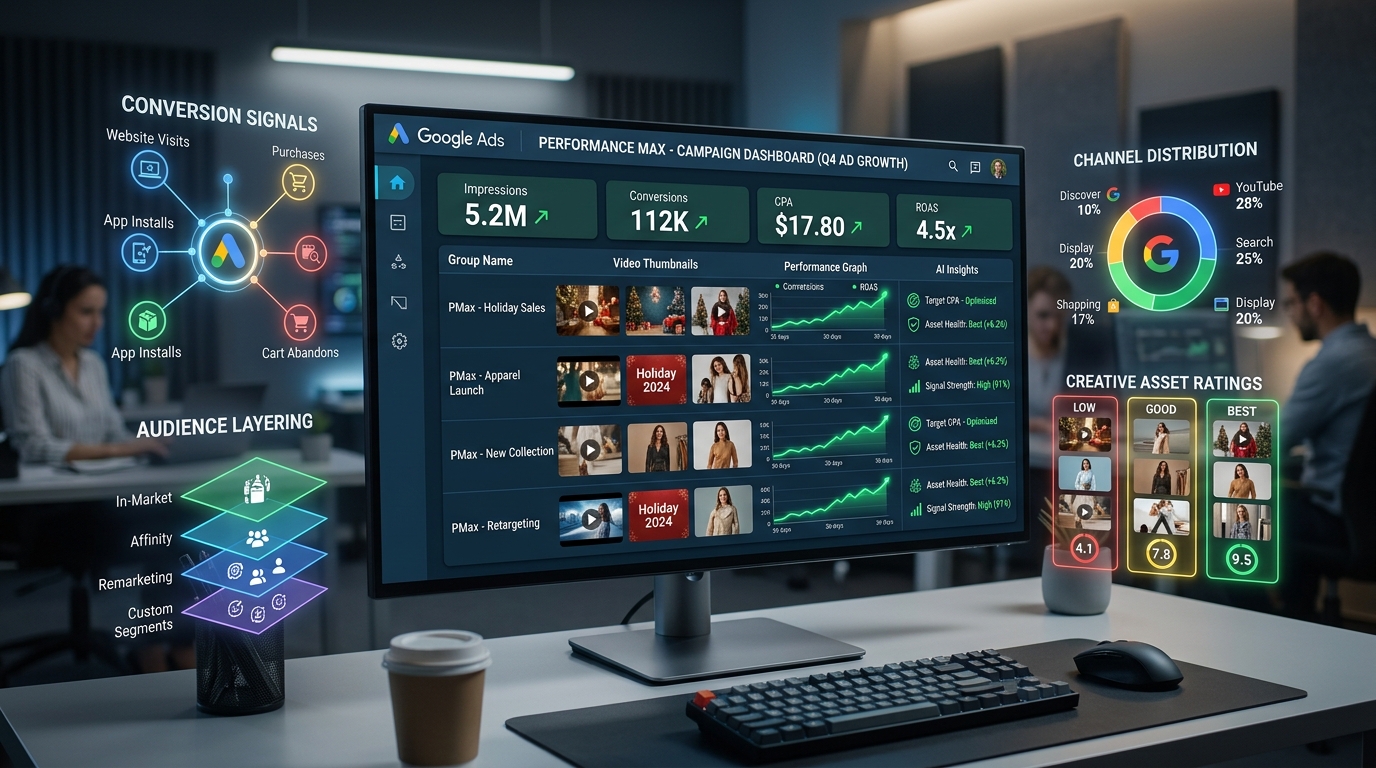
Performance Max now accounts for 45% of all Google Ads conversions, processing over 2.5 billion ad impressions daily across Search, Shopping, Display, YouTube, Gmail, Discovery, and Maps. Video-enabled asset groups deliver 25-40% better performance than image-only campaigns, while Google’s algorithm evaluates 10,000x more creative variants simultaneously than previous systems. Yet 67% of advertisers still run Performance Max like it’s 2023 single campaigns with minimal creative variation, leaving substantial gains on the table.
The shift isn’t temporary; it’s fundamental to Google’s architecture. Performance Max moved from experimental campaign type to the platform’s dominant conversion driver. Recent 2026 updates introduced channel performance reporting, negative keyword capabilities, brand exclusions, and URL controls addressing “black box” complaints from early versions. The advertisers seeing 30-50% better returns aren’t fighting automation; they’re designing better signals, controlling inventory strategically, and treating campaigns as systems requiring continuous optimization.
Success with Performance Max in 2026 doesn’t require six-figure budgets or agency teams. It requires understanding how to design conversion signals that guide AI toward real demand, structuring asset groups for algorithmic efficiency, and implementing systematic testing frameworks that compound performance improvements monthly. This guide shows you advanced strategies that separate top-performing accounts from those still struggling with basics.
Why Signal Design Determines Performance Outcomes
Google’s AI optimizes precisely toward the conversion signals you provide. Most performance problems trace back to signal design, not budget, creative, or targeting making this your highest-leverage optimization area.
Separate Discovery from Conversion Events
Performance Max’s default conversion signals often favor retargeting and view-through attribution, inflating reported ROAS while true efficiency suffers. The fix: define primary conversions as bottom-funnel actions (purchase, qualified lead) and exclude or deprioritize awareness metrics (page views, video watches). Campaigns optimizing toward 10+ conversion events with equal weight consistently underperform those with clear hierarchies by 35-50%.
Implement New Customer Acquisition Goals
Google introduced New Customer Acquisition features in 2026, letting you bid specifically for first-time buyers versus repeat customers. This addresses Performance Max’s tendency to over-serve existing customers who would have converted anyway. Accounts using NCA goals typically see 20-30% improvement in true incrementality by shifting spend toward net-new revenue generation.
Feed Value-Based Bidding Data
Upload profit margins or cost of goods sold so Google understands the difference between a $100 sale with 10% margin versus 50% margin. Value-based bidding consistently achieves 20-40% better true ROAS than simple conversion counting. Google’s incremental attribution feature launched in Q4 2025 and drove 24% more incremental conversions by focusing spend on users who wouldn’t convert without seeing ads.
Controlling Inventory Through Campaign Segmentation
Strategic campaign structure balances Google’s need for data consolidation against your need for budget control and strategic allocation across different business priorities.
Segment by Product Margin or Inventory
Create separate campaigns for high-margin products versus volume drivers. This prevents Google from spending 80% of its budget on high-volume, low-margin items while ignoring profitable segments. The rule: segment when each campaign will receive 30+ monthly conversions below that threshold, consolidation performs better than fragmentation.
Use Listing Groups for Budget Priority
Within campaigns, structure listing groups hierarchically with separate bids for brand versus non-brand traffic, promotional items versus evergreen catalog, or seasonal products requiring aggressive spend. Advanced advertisers use dynamic listing groups that automatically shift products between campaigns based on real-time inventory and predicted profitability.
Implement Channel-Specific Exclusions
February 2026 updates enabled placement-level exclusions for Performance Max. Review search partner placements weekly and exclude low-quality sites where cost-per-conversion exceeds channel benchmarks by 40%+. This tactical inventory control redirects wasted spend toward higher-performing channels without restricting Google’s exploration capabilities.
Building Asset Groups That Feed Algorithm Learning
Asset quality and variety directly determine how effectively Google’s AI assembles ads for different contexts. Most accounts leave 30-40% performance gains on the table through insufficient asset diversity.
Create One Asset Group Per Product Category
Each asset group should focus on a specific product line or customer intent mixing enterprise software assets with SMB-focused messaging confuses the algorithm and lowers quality ratings. The practical rule: if you wouldn’t show every asset to every audience in the group, split them. Most accounts need 3-8 asset groups total.
Fill Every Asset Slot With Unique Concepts
Campaigns with 15 headlines, 5 descriptions, 20 images, and 5 videos consistently outperform minimal setups. This isn’t about slight variations Google needs genuinely different concepts, tones, and approaches. The brands seeing the strongest performance rotate 8-20 distinct creative concepts monthly rather than optimizing the same ads endlessly.
Replace Low-Rated Assets Systematically
Google rates each asset as Low, Good, or Best based on relative contribution. Replace Low performers after 4-6 weeks of data accumulation. This isn’t punitive, it’s recognizing that some creative simply resonates better. Continuous asset testing and replacement drives 10-20% performance improvements over static groups. Video-enabled groups particularly benefit from this rotation as Google increasingly favors video placements.
Leveraging Audience Signals for Smarter Exploration
Audience signals guide initial AI exploration without restricting who actually sees ads. Think of them as suggestions that inform bidding rather than hard targeting boundaries.
Layer Multiple Signal Types
Create combined audience signals using lookalike audiences based on best customers, plus in-market segments for your category, plus custom segments from high-intent keywords. Triple-layered targeting typically delivers 3-4x better ROAS than untargeted prospecting. The power emerges from a combination of each signal type, which provides different optimization inputs.
Upload Customer Match with Revenue Data
Export high-lifetime-value customer lists (email, phone, address) as Customer Match audiences. Performance Max campaigns with strong first-party data signals find similar high-value prospects 3-4x more effectively than campaigns without customer lists. Include purchase value and frequency data when possible. This teaches Google what “good customer” actually means for your business.
Use Search Themes for Brand Control
Search themes let you explicitly tell the AI about your unique selling points and relevant topics. Include commercial modifiers like “buy,” “pricing,” “best,” or “near me” where relevant. Check Search Terms reports monthly and add themes for high-converting patterns the algorithm discovered. This creates feedback loops where machine learning informs human strategy, which guides machine learning.
Implementing Advanced Bidding Strategies
Performance Max bidding isn’t set-and-forget. Strategic bidding approaches adapt to business cycles, inventory constraints, and performance patterns that emerge from ongoing optimization.
Start Conservative, Then Optimize Progressively
Set initial Target ROAS 30-50% higher than break-even to give algorithms room for learning. Once campaigns deliver 30+ conversions monthly, gradually lower targets 5-10% weekly while monitoring volume and efficiency trade-offs. Aggressive initial targets restrict volume before AI understands conversion patterns. Patience during learning phases pays exponential dividends.
Enable Smart Bidding Exploration Selectively
This 2025 feature lets Google experiment with 20% of the budget outside your target while maintaining overall performance. Only available when campaigns have 400+ monthly conversions, but consistently discovers profitable traffic that manual targeting would miss. Smart Bidding Exploration increased unique converting query categories by 18% and overall conversions by 19% in Google’s published benchmarks.
Adjust Bids by Device and Location
Performance Max finally offers bid adjustments (though limited compared to traditional campaigns). Review device and geographic performance monthly if mobile converts 40% worse than desktop, implement a -15% to -20% mobile bid adjustment. Geographic analysis often reveals surprising efficiency variations where certain regions dramatically outperform or underperform.
Testing Framework for Systematic Improvement
Advanced Performance Max optimization requires structured testing that isolates variables and compounds improvements over time rather than making random changes that muddy attribution.
Run Uplift Experiments for Incremental Value
2026 introduced Uplift experiments showing incremental gains of including Performance Max alongside other campaign types. The control receives 50% traffic without Performance Max; treatment includes Performance Max plus comparable campaigns. This quantifies whether Performance Max actually generates net-new conversions or cannibalizes existing traffic, critical data for strategic budget allocation.
Test Creative Concepts, Not Iterations
Real testing means running fundamentally different approaches simultaneously, benefit-focused versus feature-focused messaging, user-generated content versus professional photography, problem-agitate-solve versus aspirational positioning. Testing slight headline variations within the same concept provides marginal gains; testing completely different strategic approaches unlocks step-function improvements.
Monitor CPMr as Fatigue Indicator
Cost per 1,000 reach (CPMr) measures what you pay to show ads to the same audience repeatedly. Healthy CPM stays below $20 when it spikes, you’re paying premium rates reaching exhausted audiences with stale creative. CPMr is your early warning system, triggering proactive creative refreshes before performance visibly declines.
Scaling Campaigns Without Performance Degradation
Once campaigns prove profitable at initial budgets, strategic scaling unlocks growth. Most advertisers scale incorrectly, with sudden budget increases that force relearning, destroying weeks of optimization progress.
Increase Budgets 15-20% Weekly
Gradual increases maintain learning stability while expanding reach. Sudden doubles force Google’s AI to re-learn conversion patterns, typically causing 2-3 weeks of suboptimal performance. The old “10% daily increases” rule became outdated with newer algorithms. Weekly 15-20% raises provide a better balance. Most campaigns can scale 3-5x before hitting audience saturation.
Expand Through Creative, Not Budget
When hitting performance walls, add new creative variation rather than increasing the budget on existing winners. Fresh concepts expand addressable audiences more effectively than budget increases on fatigued creative. Accounts with high creative testing velocity, 8-20 new concepts monthly, scale more efficiently because they’re constantly unlocking new audience segments.
Launch Complementary Campaign Types
After Performance Max proves successful, add traditional Search for brand protection or Shopping for specific product line control. The Power Pack framework, combining Performance Max, Demand Gen, and AI Max for Search, delivers 25-35% higher conversion rates than single-campaign-type strategies. Different campaign types serve different funnel stages more efficiently than trying to make one campaign do everything.
Start Optimizing Your Performance Max
Performance Max in 2026 rewards strategic signal design and systematic optimization over set-and-forget automation. The brands winning now guide Google’s AI with quality inputs rather than fighting automation with outdated control tactics.
Audit your conversion signals first. Define primary revenue-generating conversions clearly, implement New Customer Acquisition goals, and feed value-based bidding data showing profit margins. Everything else depends on this foundation. Without clean signals, you’re teaching the AI to optimize toward low-value actions that inflate reporting while real efficiency suffers.
Restructure campaigns for strategic segmentation. Segment by product margin or inventory goals when each campaign will receive 30+ monthly conversions. Use listing groups for budget priority and implement channel-specific exclusions based on February 2026 placement reporting. Consolidation beats fragmentation until conversion volume supports meaningful segmentation.
Build comprehensive asset libraries immediately. Create 3-8 asset groups focused on distinct product categories or customer intents. Fill every asset slot with unique concepts 15 headlines, 5 descriptions, 20 images, 5 videos minimum. Replace Low-rated assets quarterly and rotate 8-20 new creative concepts monthly to feed Google’s algorithm the variety it needs.
Test systematically through structured experiments. Run Uplift experiments quantifying incremental value, test creative concepts rather than iterations, and monitor CPMr as your fatigue early warning system. Scale through creative expansion and complementary campaign types rather than forcing budget increases through fatigued ads.
The advertisers dominating Performance Max in 2026 started optimizing months ago. They built proper signal architecture, implemented strategic campaign structures, and established systematic testing frameworks that compound improvements monthly.


Leave a Reply